
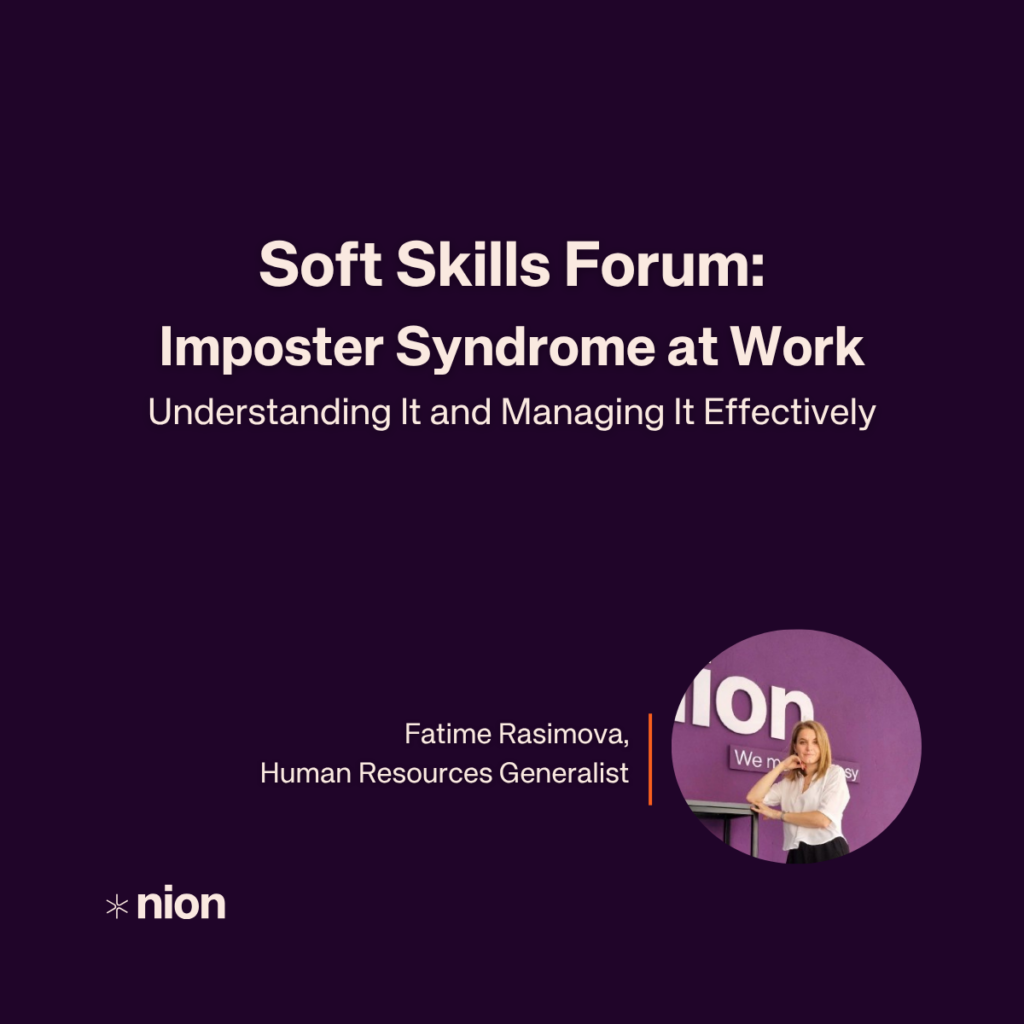
What Imposter Syndrome Really Is
Imposter syndrome isn’t a clinical diagnosis. It’s a pattern of thinking, a persistent feeling that you’re not as competent or capable as others think you are, despite clear evidence of your accomplishments. It’s the voice in your head that says you’re a fraud, even when you’re doing well. You might feel like you don’t belong, that you got lucky, or that you’re one mistake away from being “found out.”
The signals often appear as:
- Difficulty accepting praise
- Over-preparing to compensate for perceived inadequacy
- Attributing wins to external factors
- A nagging anxiety that the next task will be the one that exposes you
And the challenge? These feelings often exist alongside real achievement. You deliver excellent work, receive recognition, and still question whether you truly deserve to be where you are.
The Five Types of Imposters
During the session, Fatime explored five common patterns that imposter syndrome takes:
The Perfectionist – “Perfect or a failure.” If something isn’t flawless, it feels like failure. This type spends disproportionate time perfecting one deliverable while other work suffers, believing they need to be perfect just to be adequate.
The Expert – “Must know everything first.” Feels fraudulent if there’s something they don’t know yet, delaying action until they’ve mastered every detail.
The Natural Genius – “Should be easy if I’m good.” If something requires effort or multiple attempts, it’s interpreted as evidence of inadequacy rather than normal learning.
The Soloist – “Asking for help equals fraud.” Believes they must accomplish everything independently, viewing collaboration or support as proof they don’t deserve their position.
The Superhuman – “Excels at everything, always.” Measures worth by how many roles they can juggle simultaneously, leading to burnout in pursuit of validation.
Recognizing which pattern resonates can be the first step toward managing it.
Reframing Your Thoughts
One of the most practical tools shared in the session was learning to reframe common imposter thoughts:
- “I just got lucky” → “I created the opportunity”
- “Anyone could do this” → “But they didn’t. YOU did”
- “They’ll expose me” → “Not knowing is not being fake”
- “I don’t deserve this” → “I EARNED this”
Perhaps the most powerful moment came when Fatime shared her own experience preparing to present on this very topic. Despite understanding imposter syndrome intellectually, she still felt it surfacing as she prepared. But she made a conscious choice to reframe her thinking—moving from “I can’t do this” to “let me try and see what happens.”
That reframing is often the first step. It doesn’t make the feelings disappear entirely, but it stops them from controlling your decisions.
A Four-Step Toolkit for managing Imposter Syndrome at Work
The session offered practical strategies for managing imposter syndrome when it surfaces:
1. Keep a Win Log – Track your accomplishments. When doubt creeps in, facts provide grounding that feelings can’t erase.
2. Share It – Tell one person. Speaking the feeling out loud often diminishes its power and reminds you that you’re not alone in experiencing it.
3. Facts Over Feelings – List concrete proof of your skills and contributions. Evidence counters the narrative that you’re inadequate.
4. Practice Self-Compassion – Ask yourself: What would you tell a friend experiencing these same doubts? Extend that same kindness to yourself.
Final Thoughts
If you feel like an imposter, it usually means you’re pushing yourself to grow. You’re in spaces that challenge you. You’re taking on work that matters.
Remember: Skills got you here. Making a mistake doesn’t make you a fraud. You bring unique value. And growth feels uncomfortable, that discomfort isn’t evidence you don’t belong.
As the session concluded: “The next time you’re tempted to say ‘I got lucky,’ remember: Luck might have opened the door, but your effort is what kept you in the room.” Because imposter syndrome isn’t something you master once. It’s something you learn to navigate—for as long as you keep growing.